

Read the Email
What he said in public, what his Secretary said in private, and what the developer asked for in between.

Surveillance Centers, Part 4

Last Wednesday in Pennsylvania, the Office of the Governor performed accountability in two places at once.
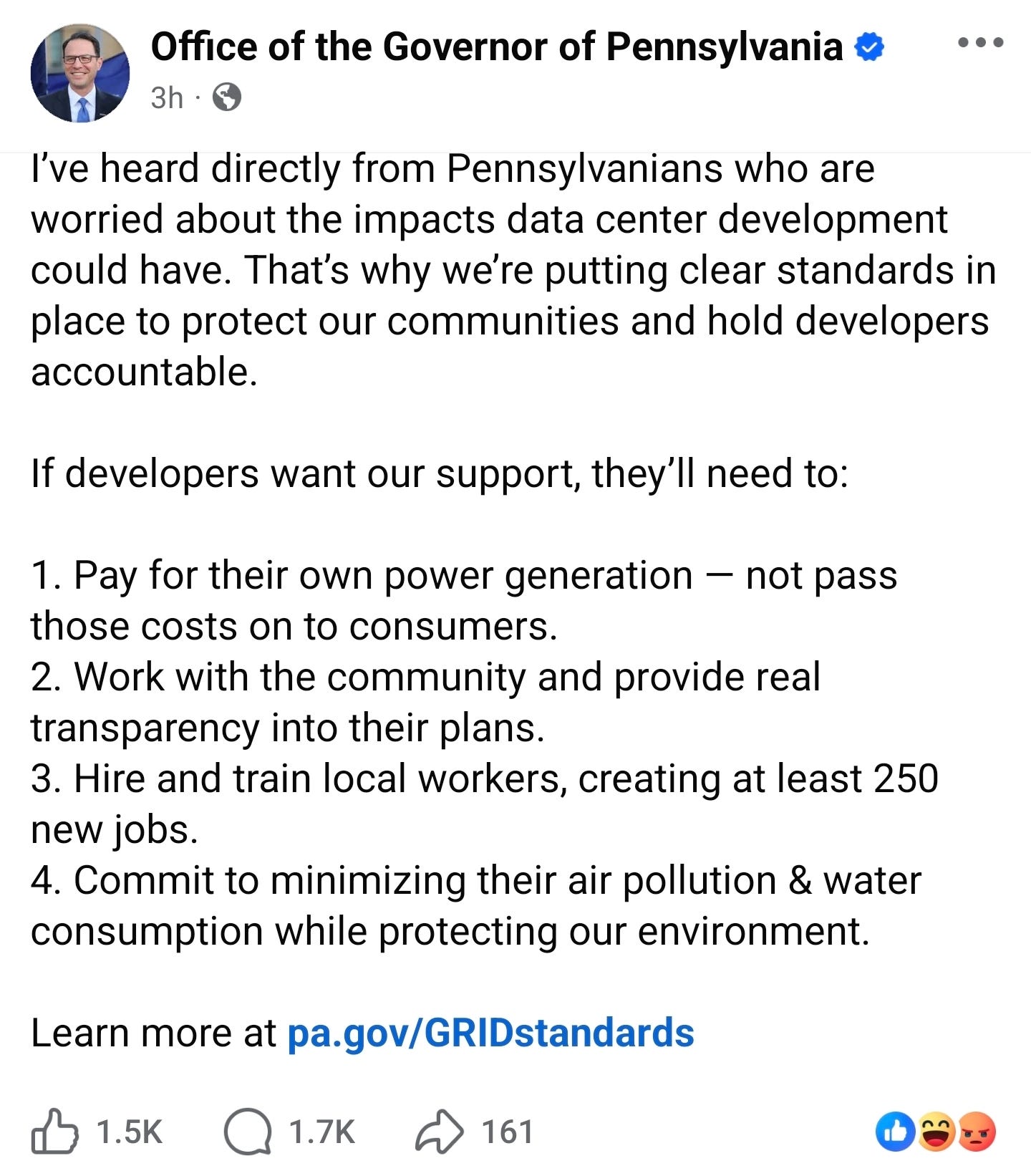
In Harrisburg, the Governor's office released the official text of the GRID standards he first announced in February's budget address. GRID stands for the Governor's Responsible Infrastructure Development standards. The public message was firm. Communities would be protected. Developers would be held accountable. To reporters in Lackawanna County that afternoon, the Governor went further. He said developers who chose to ignore GRID would not get their tax breaks, would not get timely permits, and would face what he described as a near impossibility of building here. Ignore the administration, ignore GRID, and you do so "at your own peril."
It sounded like a regulation.
At nearly the same hour, the Governor walked into State Representative Kyle Mullins's office in Blakely, in Lackawanna County, for what local reporters described as an impromptu meeting with residents about the AI data center invasion of nearby Archbald Borough.
The visit had not been publicly announced.
A small handful of residents made it, including Michael Pilch of the community group Stop Archbald Data Centers. He told WVIA afterward that the Governor seemed to understand the residents' concerns. I am glad Mr. Pilch was in the room. The complaint is not that he was. The complaint is that an entire borough facing six data center campuses, fifty buildings, more than thirteen million square feet of construction, and a combined water draw of at least 4.5 million gallons per day was given no chance to attend a meeting their Governor staged in their own neighborhood to discuss exactly that.
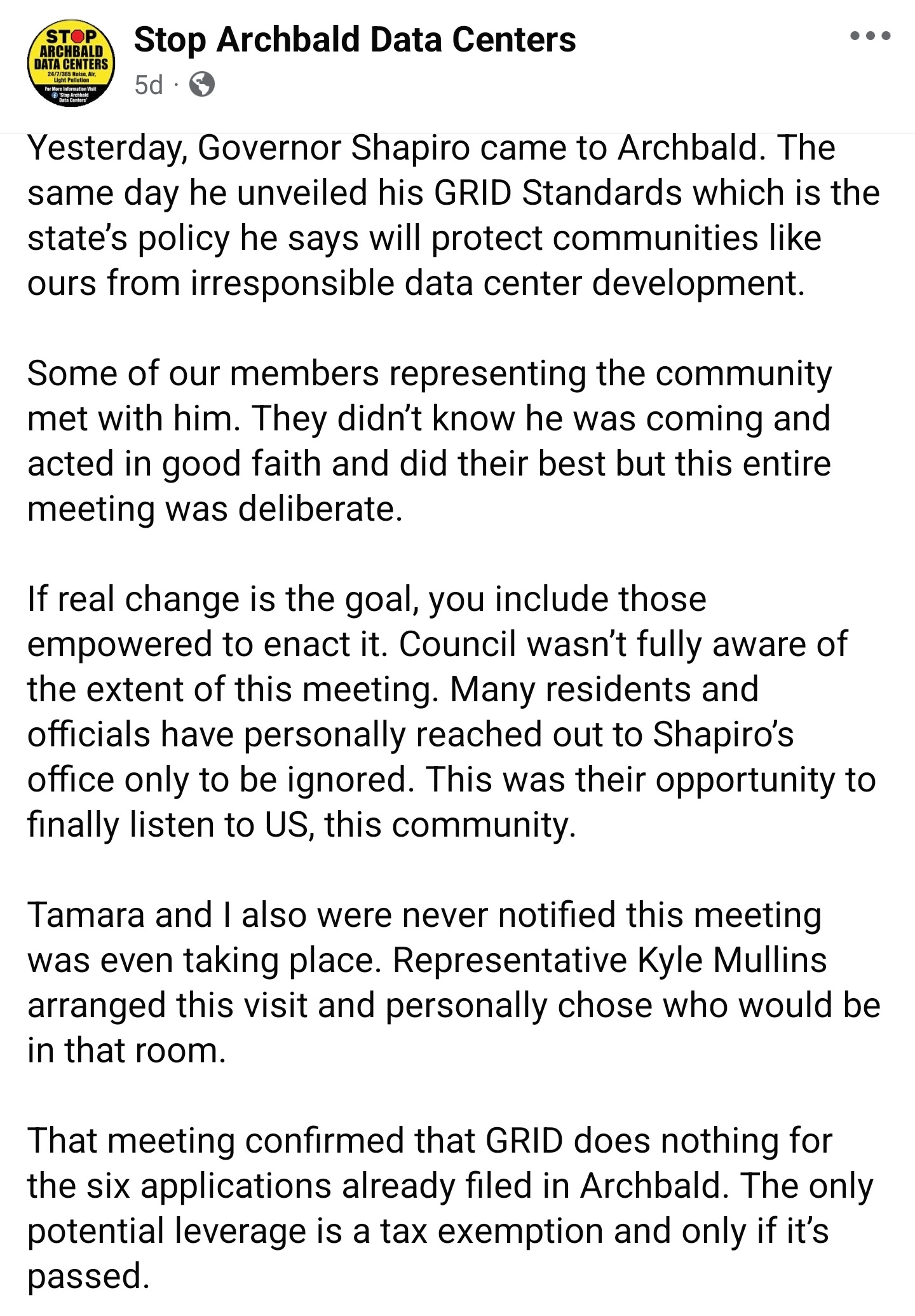
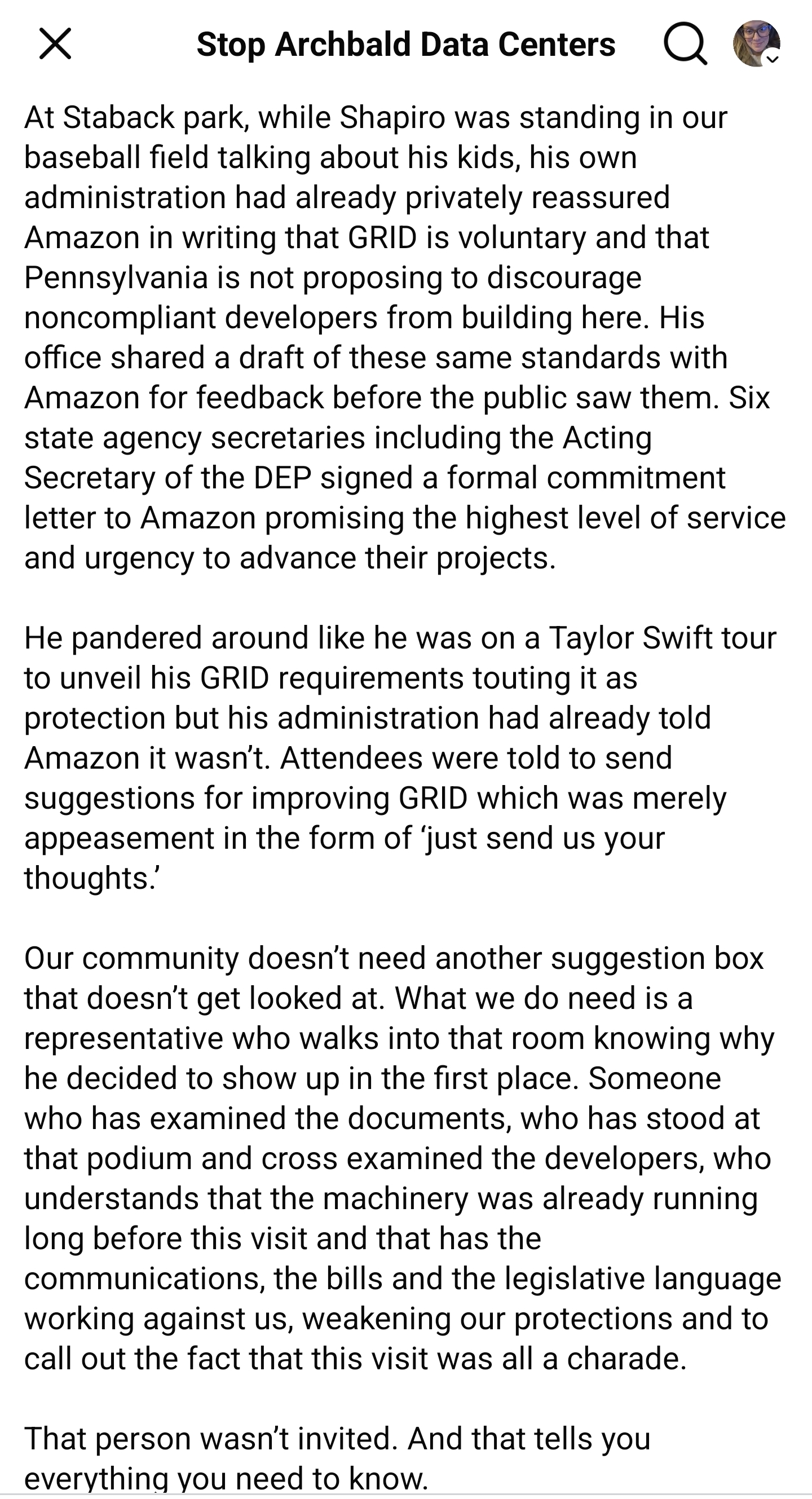
Listening tours are public, scheduled, and open. What happened on Wednesday was a press availability with selected attendees. The difference matters.
Most of the people who have been organizing against these projects for months did not know the visit was happening. The Archbald police department did not know. Across local community pages by the late afternoon, the same simple question kept appearing: who, exactly, was invited?
A listening tour the community is not told about is not a listening tour. It is a press availability with selected attendees.
What He Said in Public
Standing in left field at Ed Staback Memorial Park in Archbald, after the office meeting, the Governor told reporters about his vision for GRID. He used confident, mandatory language. Developers would not get state support if they ignored the standards. The standards would protect the environment. They would put Pennsylvanians first.
He also said something quieter, which deserves attention.
He admitted that on the question residents most wanted answered, the cumulative impact of multiple data center campuses landing on top of one another in a small borough, the Commonwealth would be "constrained somewhat legally" in what it could do.
That is the Governor of Pennsylvania, in his own voice, in the affected community, acknowledging that the legal framework his GRID standards operate within does not allow the state to weigh whether thirteen million square feet of surveillance infrastructure can fit into seventeen square miles of borough. Each project gets reviewed alone. The total is somebody else's problem.
That admission tells you everything about the actual reach of GRID, which is to say, not much.
Read the Email
But you do not have to take my word that GRID has less teeth than the Governor's Wednesday remarks suggested. The Governor's own Secretary of Community and Economic Development put it in writing months ago.
On February 3, 2026, the morning of the budget address where GRID was first announced, Secretary Rick Siger of the Pennsylvania Department of Community and Economic Development sent an email at 8:51 a.m. He addressed it to his colleagues at Amazon Web Services. Before the budget address. Before the public knew what GRID was.
The email was obtained through a Right-to-Know request filed by Colby Wesner, a pediatric medical professional who serves as Vice President of Concerned Citizens of Montour County. Wesner has been doing what most reporters at the state level have not: filing public records requests, posting the documents in full, and explaining them in plain English. Without his work this email would not be public. Without Ginny Marcille-Kerslake, a senior organizer at Food & Water Watch Eastern Pennsylvania, surfacing it again last week alongside the official GRID rollout, the email might still be sitting in a database while the Governor's communications team finished their victory lap.
What does the email say?
It says the principles announced that day were "intended to be voluntary."
Read that phrase again.
Voluntary.
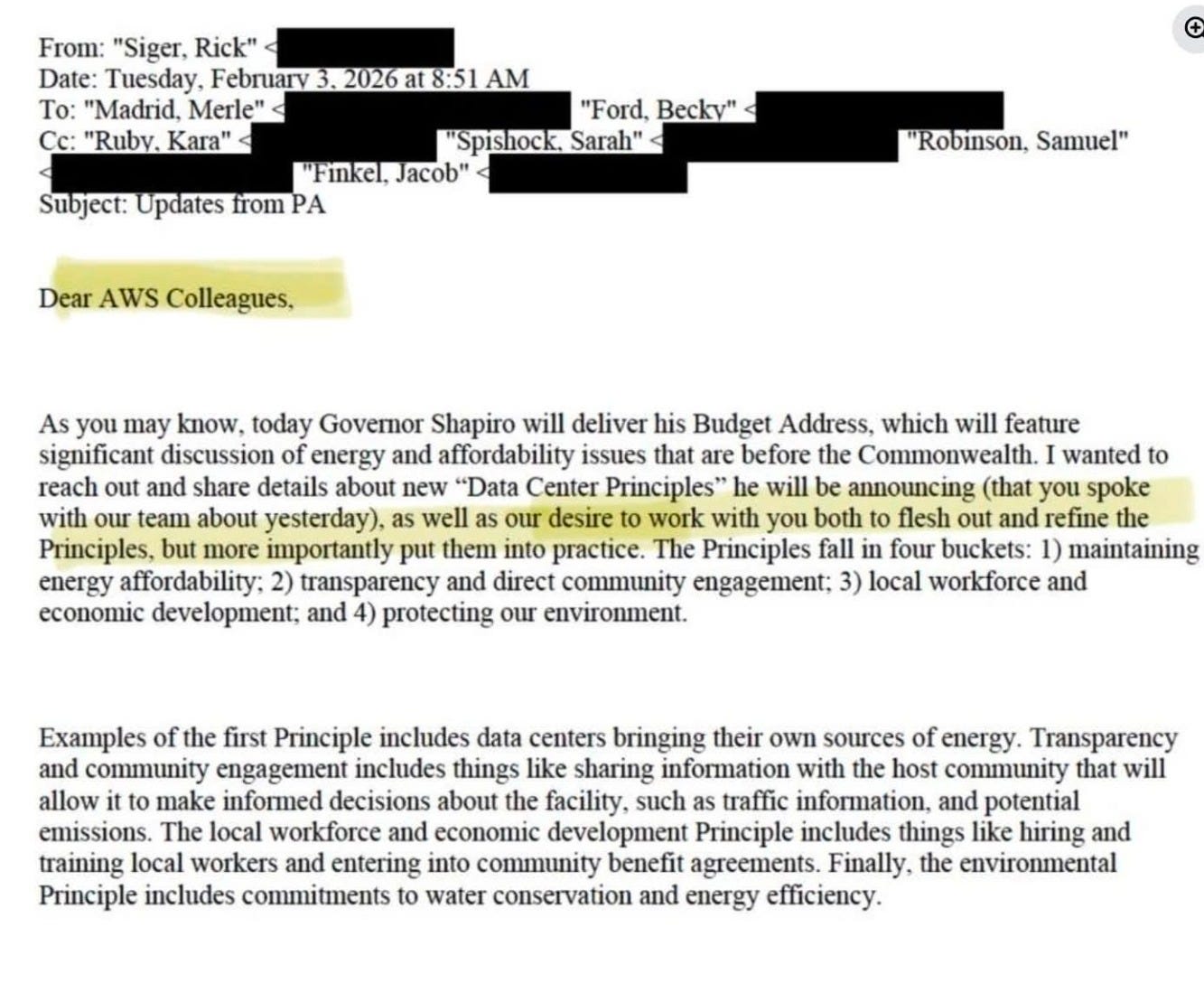
The Secretary went further. He told Amazon explicitly that the Governor was not proposing to ban, or even to discourage, data centers that chose not to follow the principles from siting in Pennsylvania anyway. Companies could build here either way. The principles would only determine whether they qualified for state support: faster permitting, favorable tax treatment, a stamp of approval. Like a LEED certification for a building, the Secretary explained, with tiers and benefits and the option to participate or not.
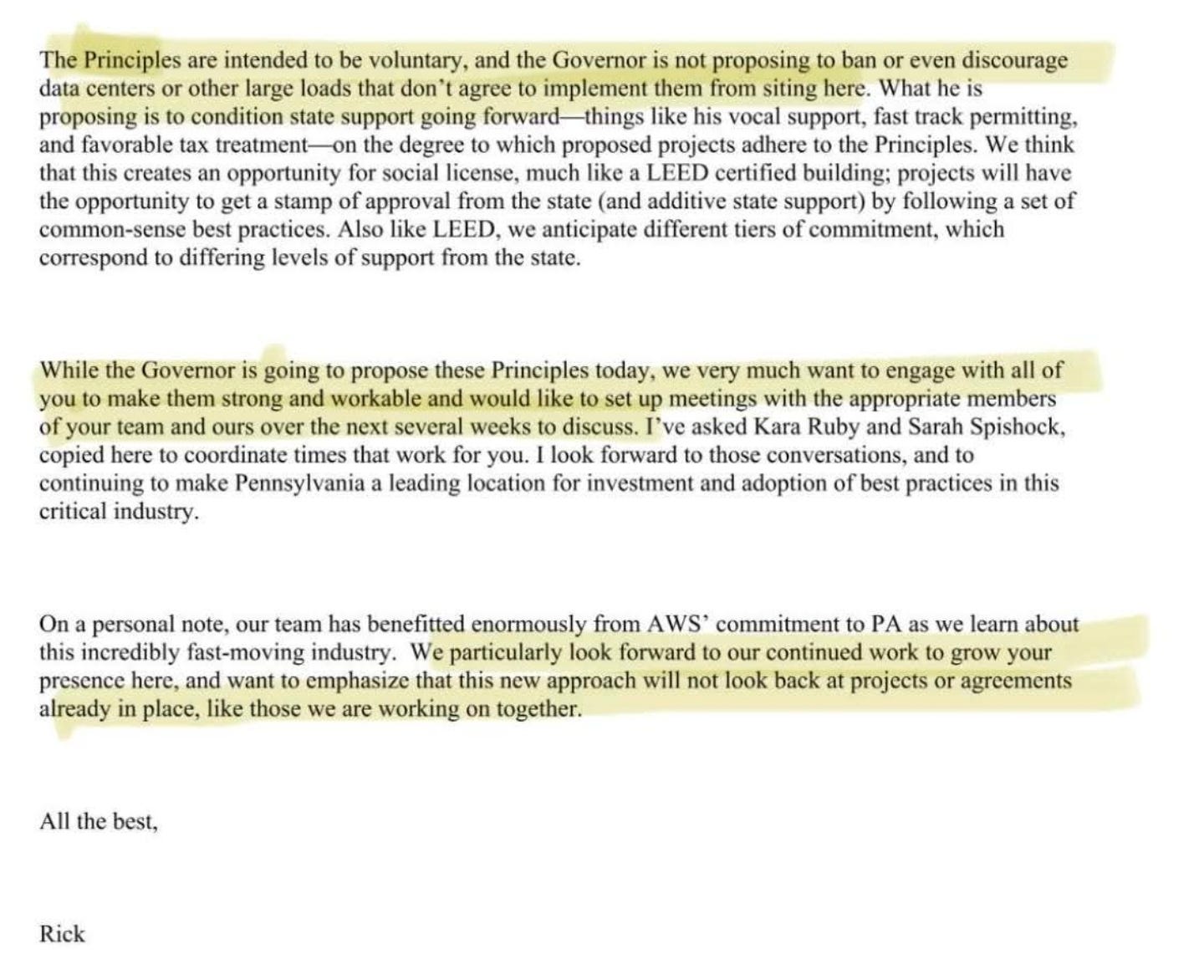
That is not what a regulation looks like. That is what a marketing program looks like.
And the email did one more thing. The Secretary reassured Amazon that the new approach would not reach back to deals already on the table. Projects and agreements already in motion, including ones the state was actively working on with AWS, would be carved out.
That carve-out matters more than the rest of the email put together.
The 400,000 gallons a day Middlesex Township signed away in February? Exempt. The four data center applications Brian O'Neill of MLP Ventures put in front of the Upper Merion Township Planning Commission, which I detailed in Part 2? Exempt. The 4.5 million gallons a day proposed for Archbald right now? If those projects are "already in place," and the developers will absolutely argue that they are, exempt.
The GRID standards announced last week, in other words, apply to almost nothing currently happening in Pennsylvania.
The public threats are for the public. The private reassurances are for Amazon.
Read the Other Email
The same Right-to-Know request produced a second email worth your time.
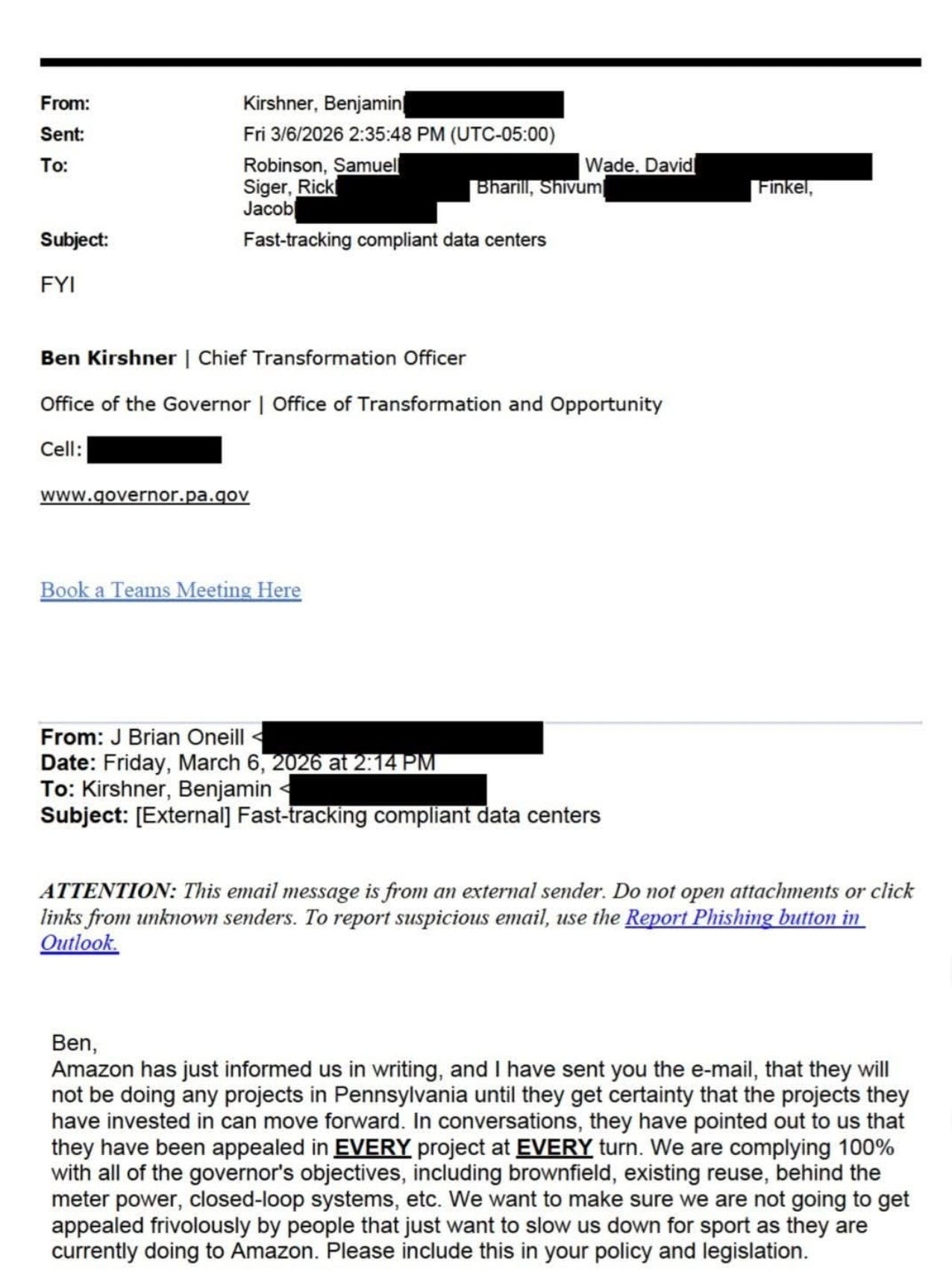
On March 6, 2026, about a month after Secretary Siger's note to Amazon, a different email landed in the inbox of Benjamin Kirshner, the Shapiro administration's Chief Transformation and Opportunity Officer. The sender was Brian O'Neill.
O'Neill is not a name I am introducing for the first time. I wrote about him in Part 2. He is the King of Prussia developer behind four of the five data center applications I detailed in Upper Merion Township. The man whose own contractors sued him last year over unpaid invoices at his existing campus. The man whose largest proposed Upper Merion site sits on a former superfund property with four inactive quarries.
He was not writing the Governor's office to defend his projects.
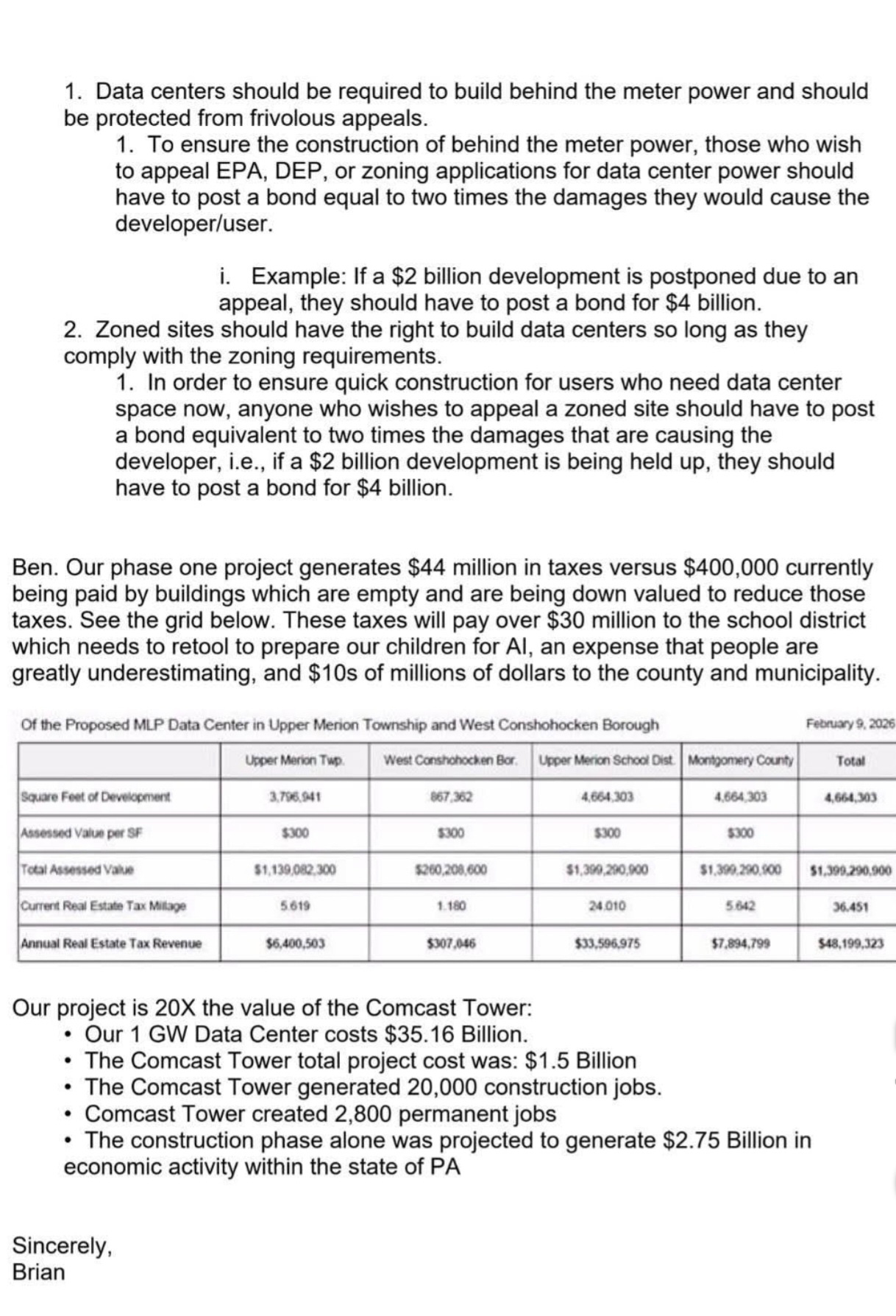
He was writing the Governor's office to ask the Shapiro administration to support policies that would make it harder for citizens to appeal data center zoning and permit decisions. According to public reporting on the email, he attached suggested lobbying language for the administration to consider.
A developer with active applications across multiple Pennsylvania townships sent the Governor's office a draft policy designed to weaken the legal mechanisms by which the public can challenge his own projects.
He did not send it to a legislator. He sent it to the office whose entire job is to coordinate state support for industries the administration wants to attract.
There is no public report that anyone in the Shapiro administration told him no.
What the Documents Show
Place these four things in front of you.
The Governor's public remarks last Wednesday, in which the GRID standards were described in confident, mandatory language and the consequences of ignoring them were described as severe.
The Secretary's February email, in which the same standards were described to Amazon as voluntary, non-binding, and exempt from anything already in motion.
The developer's March email, in which the Shapiro administration's open door received a request to weaken citizens' ability to challenge data center projects.
And the Wednesday stage management. A surprise visit to Lackawanna County to "listen to residents" about a buildout that would consume four-and-a-half million gallons of the public's water every day. Held without telling the community.
That is not a pattern of accountability. That is a pattern of stage management. The accountability is the script the public is asked to read aloud. The reality is whatever Amazon Web Services, MLP Ventures, and the Office of Transformation and Opportunity agree to in the rooms the public has not been invited to enter.
Five days have now passed since the GRID rollout. The Office of the Governor has issued press releases. It has not responded, on the record, to the contents of either email. If anything in this paragraph is wrong, I would like that response in writing, in a forum the residents of Archbald, Middlesex Township, Upper Merion, and Montour County can actually read.
The Constitution They Will Not Quote
In Parts 2 and 3 of this series I wrote about Article I, Section 27 of the Pennsylvania Constitution. Public natural resources, including pure water, are the common property of all the people of this Commonwealth, including the generations not yet born. The Commonwealth is the trustee. The Pennsylvania Supreme Court made that promise legally enforceable against state and local government alike in PEDF v. Commonwealth in 2017.
Nothing in the GRID standards released last week mentions Article I, Section 27.
Nothing in the Secretary's email to Amazon mentions it.
Nothing in the developer's lobbying email mentions it.
Nothing in any of the Governor's remarks on Wednesday, in Harrisburg, in Mullins's office in Blakely, or in left field at Ed Staback Memorial Park in Archbald, mentions it.
The single piece of law that already binds the Commonwealth as trustee of the people's water has been carefully, consistently, and conspicuously left out of every document and every statement the state has produced about the largest water draw in modern Pennsylvania history.
The Governor told reporters Wednesday that he was "constrained somewhat legally" on cumulative impacts. There is one piece of Pennsylvania law that constrains him in the opposite direction, requiring him to act as trustee of the public's water for all the people including those not yet born. He has not invoked it. Neither has anyone in his administration. Neither, to my knowledge, has any developer's lawyer, because they would prefer he keep forgetting it exists.
The Legal Toolbox He Won't Open
Section 27 is not the only tool the Governor has declined to pick up.
The Pennsylvania Constitution is the most powerful one available to him. Article I, Section 27 designates the Commonwealth as trustee of the public water, and the Pennsylvania Supreme Court has affirmed that this duty is enforceable against every level of state and local government. A governor who is trustee of the public water has more than the authority to regulate data centers. He has a constitutional duty to conserve what they propose to drain. He has not invoked it.
Federal law is the second tool. These are not passive filing cabinets. They are the infrastructure behind the largest cloud computing platforms in the world, including Amazon Web Services, which holds active contracts with the CIA, the Department of Defense, and the Department of Homeland Security. Section 889 of the National Defense Authorization Act already prohibits federal agencies, their contractors, and recipients of federal funds from using telecommunications and surveillance equipment manufactured by specific Chinese companies. The Buy America Act requires American-manufactured materials in federally-funded construction. Pennsylvania is handing these developers state support, including tax breaks, expedited permits, and favorable treatment, without requiring them to certify compliance with the same federal security standards that apply the moment their facilities serve a federal customer.
Texas has shown what an aggressive state looks like on this front. Texas enacted Senate Bill 17 restricting Chinese, Iranian, and Russian government-owned entities from purchasing Texas real estate near critical infrastructure. The Texas Attorney General has filed coordinated consumer protection lawsuits against Chinese-linked technology companies, calling their products "modern weapons of war" capable of enabling foreign surveillance and attack of American households and networks. Federal prosecutors in Texas secured a guilty plea from a contractor who passed off Chinese-made products as American under the Buy America Act. Texas decided that if something is surveillance infrastructure touching American security, it is going to demand accountability for what goes inside it and who builds it.
Pennsylvania has every one of those tools. The Governor has the ability to condition every dollar of state support and every fast-tracked permit on full federal security compliance certification. The Attorney General has consumer protection authority. The legislature has real estate restriction authority.
He has used none of it. He released a certification program that is voluntary, grandfathered the deals already on the table, and stood before the people of Archbald telling them the state's hands were tied.
The constraint is not the law. The constraint is the choice.
The Fight Is Working
Here is the part the Governor's communications team would prefer you not notice.
In February, the people of Montour County beat the rezoning that Talen Energy and Amazon Web Services wanted. Four neighbors started at a kitchen table in August. They had three thousand signatures by February. They held town halls the state was invited to and did not attend. They filed Right-to-Know requests. They won.
Today, Stop Archbald Data Centers is doing the same work in Lackawanna County, and Michael Pilch's quiet, informed conversation with the Governor in Blakely is a piece of that. Concerned Citizens of Montour County is still pulling records. Food & Water Watch is organizing across the Commonwealth. The Conservative Voice is on the air. Readers of this series are showing up to township meetings in Cumberland, Montgomery, Chester, Lackawanna, and Montour counties and saying Article I, Section 27 out loud, on the record, in places where developers' lawyers sit in the back row taking notes.
The developers are noticing. That is why lobbying emails are now arriving at the Governor's Office of Transformation and Opportunity. That is why the standards announced last week are voluntary in writing while being described as mandatory in front of cameras. That is why the visit to Lackawanna County was not announced to the community.
A personal tidbit. During the research and writing of this series I received multiple solicitations from headhunters offering six-figure salaries and relocation assistance to manage the construction of these facilities. I declined. There are things worth more than a signing bonus, and this series is one of them.


They are losing the argument in public. They are now trying to win it in private.
That means the fight is working. Staying loud is the strategy.
What to Do This Week
Read the emails. Both of them. Concerned Citizens of Montour County has posted the documents in full. Read what your Governor's Secretary wrote to Amazon, and read what Brian O'Neill wrote to the Governor's office. Decide for yourself whether the public message from Wednesday matches the private messages the public was never supposed to see.
Share this piece. Send it to your township supervisors before this week's planning commission meetings. Send it to your state representative. Send it to your neighbor who still thinks the tax base argument is the whole conversation. Send it to the reporter at your local paper who has not yet asked the Office of the Governor, on the record, whether anyone in the administration told Brian O'Neill no.
If you have a comment to file with the Office of the Governor on GRID, file it in writing.
If you are an environmental lawyer in Pennsylvania, the constitutional case is sitting on a shelf waiting for the right plaintiff and the right facts. We have built you most of the facts.
The Governor showed up in Archbald last week and most of the borough did not know he was coming. The borough will keep showing up anyway, because they always have, and because the place they love is being asked to swallow thirteen million square feet of someone else's infrastructure on top of their water and their air and their quiet.
We outnumber them. They know it. That is the entire reason they keep meeting privately.
Make them meet publicly.
This series is staying free, because it matters more that it travels than that it earns. Share it. Send it to a neighbor, a supervisor, a committee person. The research, records requests, late nights, and cross-checking are reader-supported, and a paid subscription is what keeps the next one coming.
Free or paid, thank you for reading, for showing up at the meetings, and for refusing to let this be a quiet sale.
Sources & Further Reading
WVIA: Shapiro meets Archbald residents, says new data center standards will empower communities (May 27, 2026) (includes the Governor's "at your own peril" quote, his admission of legal constraints on cumulative review, and Michael Pilch's reaction)
Concerned Citizens of Montour County (Facebook) (the local organization that obtained both emails through Right-to-Know requests; vice president Colby Wesner posts the documents in full and explains them)
Heatmap News: Inside Josh Shapiro's Attempt to Navigate the Data Center Backlash
Civil Eats: How a Tiny Farm County Is Fighting Against a Data Center
Office of the Governor of Pennsylvania: GRID Standards Announcement (Facebook)
DCED: GRID Standards official page
NRDC: Governor Shapiro Releases Key Details on "GRID" Principles (notes that "the most significant and effective state guardrails will have the full force of law," which GRID does not)
LegalClarity - NDAA China Restrictions on Technology and Supply Chains
Texas Policy Research - Texas Files Four Major Lawsuits Against CCP-Linked Companies
King & Spalding - Texas AG Intensifies DTPA Enforcement Against Chinese-Affiliated Companies
GSA OIG - Texas Man Pleads Guilty To Lying About Origin of Chinese-Made Products (Buy America Act)
Pennsylvania Constitution, Article I, Section 27 - Justia
Buchanan Ingersoll & Rooney - PEDF v Commonwealth, 161 A.3d 911 (Pa. 2017)
Hang in there Ms Nester...how can I add more funds for your support? Best Wishes, John Shore